|
|
|
|
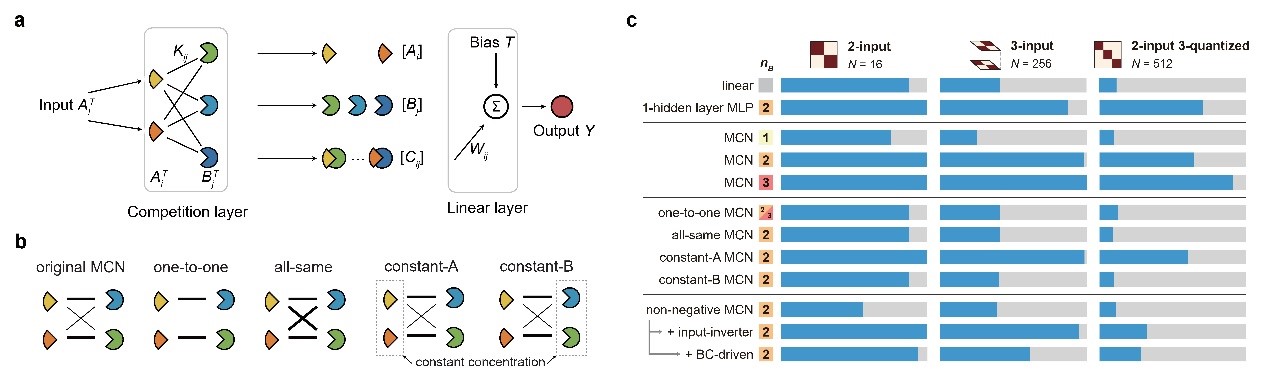
Life is capable of sensing and processing signals to adapt to changing environments while minimizing energy and resource consumption. Even individual cells exhibit complex computational behavior during processes such as cell differentiation. This information processing capability is often realized through complex molecular networks. Extensive non-specific interactions in molecular networks allow each molecule to bind to a variety of other molecules, and the limited total number of molecules leads to competition. Competition between these molecules introduces crosstalk between input signals and constitutes a hidden layer of cellular information processing. Although there is growing evidence that molecular competition contributes to efficient cellular computation, its specific computational power and computational mechanisms have not been fully revealed. Understanding the general mechanisms of such computation will not only help to reveal how cells process information efficiently, but also shed light on the design of artificial biological systems and silicon-based computational modules. In this study, we ask questions that stem from, but go beyond, cell biology: can molecular competition networks (MCNs) serve as universal computational modules? How powerful is its computational capability? What are the key factors that confer its computational power? To this end, we constructed an abstract mathematical model to describe the MCN and define its computational power by its ability to fit different functions. We chose all 2-input, 3-input, and 2-input 3-quantized Boolean functions as evaluation tasks. We trained models to fit these functions using machine learning-based optimization methods, and counted the number of functions that each model could successfully fit. The experimental results show that the MCN significantly outperforms both the linear and non-competitive models in the discrete decision-making task with analog inputs. To investigate the effect of different competitive mechanisms on the computational power, we propose competition model variants with different binding promiscuity (one-to-one, all-same) and different constant concentration (constant-A, constant-B). The results show that limited competitive resources and complex interactions are critical to the computational power of MCN, and that weak binding affinities in the network are not negligible. We find that MCN under suitable parameters is insensitive to fluctuations in the total amount of resources, but sensitive to fluctuations in the input signal. Finally, we attempted to apply MCN to a pattern recognition classification task and achieved comparable performance to Logistic Regression. These findings highlight the critical role of molecular competition in cellular computation, guiding possible paths to build efficient synthetic biocomputing modules in vivo and in vitro. Link: https://journals.aps.org/prresearch/abstract/10.1103/PhysRevResearch.6.033208 2024-10-09 15:10:31.0 |
Copyright (c) 2014-2020 All rights reserved for Wang Lab. Designed by Zheng Wei. Maintained by Zheng Wei and Wei Zhang. |